
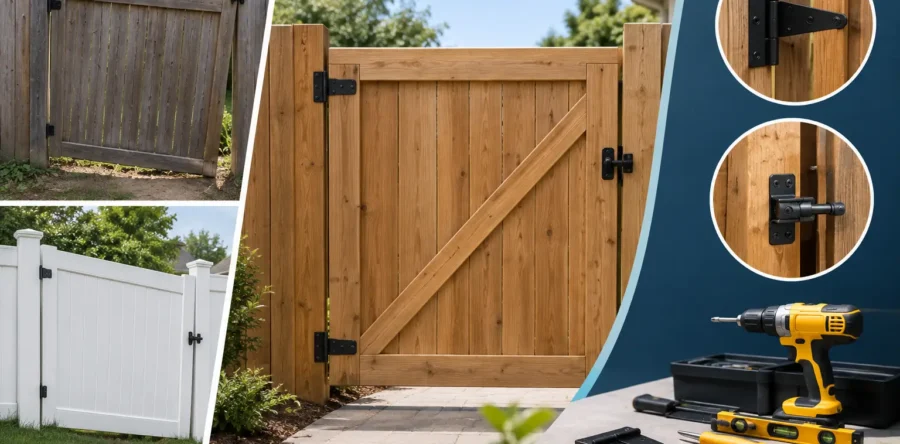
A gate that drags across concrete, misses its latch, or needs a hard lift to close is not just an annoyance. It is a structural warning. Knowing how to reinforce a sagging gate starts with identifying what is actually moving: the gate frame, the hinges, or the post supporting the entire load. Reinforcing the wrong component may make the gate look better briefly, but it will not deliver a durable repair.
A properly built gate should swing freely, align with its latch, and carry its own weight without pulling on surrounding fence panels. That takes a sound frame, correctly installed hardware, and posts that do not shift under repeated use. For Southern California properties, sun exposure, irrigation moisture, coastal air, and daily use can all speed up the failure of marginal materials or poorly installed components.
Find the Cause Before Reinforcing the Gate
Start by opening and closing the gate slowly. Watch the gap between the gate and the ground, then look at the gap along the latch side. If the latch-side top corner has dropped, the gate frame is likely sagging. If the entire gate appears lower than it once did, loose hinges or a leaning hinge post may be the real issue.
Check the hinge screws or bolts first. Hardware that has loosened in wood can pull outward over time, especially on a heavy privacy gate. Tightening fasteners may help if the holes are still solid. If the screws spin freely, the wood around them has been damaged and needs a more substantial repair than simply using longer screws.
Then inspect the hinge post. Stand a level against the post, or compare it with nearby fence posts. A post leaning away from the gate allows the hinge side to settle and puts more stress on every connection. Look for cracked concrete, rot near grade, movement in the soil, or a post that twists when the gate is opened. A gate is only as dependable as the post carrying it.
Finally, inspect the gate itself. Wood rails may be split, joints may have opened, and diagonal bracing may be missing or installed in the wrong direction. On vinyl gates, a flexible frame or missing internal reinforcement can be the source of the problem. Chain-link gates may sag because of bent tubing, worn hinges, or an undersized frame for the opening.
How to Reinforce a Sagging Gate With the Right Brace
For a traditional wood gate with a square or rectangular frame, a diagonal brace is often the most effective reinforcement. The brace transfers the load from the unsupported latch-side corner back toward the hinge side. Installed correctly, it prevents the frame from racking into a parallelogram shape.
Install the diagonal in the correct direction
The correct wood brace runs from the bottom hinge-side corner upward to the top latch-side corner. This orientation lets the brace work in compression, supporting the weight of the dropping corner. A brace installed from the top hinge side to the bottom latch side may look diagonal, but it does not support a sagging gate in the same way.
Use a straight, sturdy piece of exterior-rated lumber sized to suit the gate frame. The brace should fit tightly between the frame members rather than being loosely fastened across them. Secure it with exterior-rated structural screws or through-bolts, not small finish screws that can pull out under load.
For gates that have already sagged, lift the latch side back into proper alignment before fastening the brace. A helper can support the gate, or you can use blocking and a jack carefully beneath the outer corner. Do not force a warped gate past its natural alignment. The goal is to restore a level, functional position without creating new stress at the hinges.
Use a cable kit when a rigid brace is impractical
An adjustable anti-sag cable kit can be useful for certain wood gates, particularly when a cross brace would interfere with the gate design. The cable generally runs from the top hinge-side corner to the bottom latch-side corner, with a turnbuckle used to draw the sagging corner upward.
Cable systems are adjustable, but they are not a cure for rotted rails, loose hinges, or a failing post. They also require periodic inspection because tension can change over time. A rigid wood brace is usually the stronger long-term choice when the gate design allows it.
Reinforce the Hinges and Hardware
A well-braced gate still fails if its hinges are undersized or poorly anchored. Replace thin, bent, rusted, or worn hinges with heavy-duty hardware rated for the gate's actual weight. Wide privacy gates and driveway gates need more support than a small walk gate, and a gate that is frequently used should not rely on light residential hardware.
On wood gates, through-bolts with washers are often more secure than screws alone, particularly at the hinge-side frame. Through-bolting spreads the load across the lumber and reduces the chance of fasteners gradually pulling free. If the hinge post is sound but its bolt holes have elongated, repositioning the hardware into solid material may be necessary.
Pay attention to latch alignment after any adjustment. A gate that closes only when lifted is still carrying stress somewhere it should not. The latch should meet its catch naturally, without forcing, slamming, or pulling the gate sideways.
Do Not Ignore a Weak or Leaning Gate Post
A sagging gate is frequently blamed on the gate itself when the underlying problem is a weak post. Reinforcing a gate attached to a leaning post is like replacing a door hinge on a shifting wall. The repair may hold for a short time, but the movement continues.
Wood posts can decay below the surface even when the visible portion appears acceptable. Steel posts can bend, corrode, or be improperly sized for a heavy gate. In some cases, the post has not failed but was never set deeply or securely enough to resist the leverage created by a wide gate.
When a post is moving, replacement is often the honest repair. It can be tempting to add temporary blocks, brackets, or extra screws, but those measures rarely correct the underlying load issue. For wood fencing, a high-quality steel support system such as a Postmaster metal post can provide far better resistance to twisting, rot, and long-term movement than a typical wood post alone.
The replacement post must be matched to the gate size, weight, and use. A lightweight walk gate has different needs than a six-foot privacy gate, a ranch access gate, or a commercial enclosure. This is where material quality and installation method matter more than a quick cosmetic fix.
Match the Repair to the Gate Material
Wood gates are the easiest to brace, but they are also vulnerable to moisture damage, checking, and joint failure. If the frame is soft, split, or badly warped, adding a brace may only postpone replacement. A new, properly framed gate can be the more cost-effective choice.
Vinyl gates need manufacturer-compatible internal reinforcement, often aluminum or steel, to prevent flexing. Do not attach a wood cross brace to the face of a vinyl gate as a shortcut. It can damage the material, look out of place, and fail to address the structural support required inside the frame. Vinyl gate posts also need adequate reinforcement because the gate load is concentrated at the hinge side.
Chain-link gates generally depend on tubing strength, corner fittings, tension bars, and adjustable hinges. Bent tubing can sometimes be replaced, but a severely distorted frame should be rebuilt rather than repeatedly forced back into position. Farm and large-property gates may require upgraded hinge assemblies and stronger terminal posts due to their size and repeated equipment access.
Avoid These Common Shortcuts
Many sagging-gate repairs fail because they address the symptom instead of the cause. Avoid simply moving the latch upward to meet a dropped gate. That may make the gate close today, but it leaves the sagging frame or post under load.
Adding more screws to stripped wood is another weak repair. If the wood fibers are compromised, the screws have nothing dependable to grip. Likewise, shimming hinges can be useful for minor alignment adjustments but will not correct a post that is leaning or a frame that has racked.
Be cautious about making a gate heavier. Decorative boards, oversized hardware, and solid cladding can increase the load beyond what the original hinges and post were designed to support. A gate should be attractive, but it also needs to be proportioned for reliable daily operation.
When a Professional Repair Makes More Sense
A homeowner can often correct a minor sag on a sound wood gate with proper bracing and hardware. However, professional help is the better option when posts are shifting, the gate is unusually wide or heavy, the frame has rot, or the gate is part of a privacy, pet-safety, ranch, or commercial perimeter system.
A qualified fencing contractor can assess the full structure instead of treating the visible droop alone. That means checking post stability, selecting hardware that matches the load, rebuilding damaged framing, and making sure the completed gate has consistent reveals and dependable closure. All Season Fencing provides straightforward evaluations and tailored repair recommendations for property owners who want the work done with quality materials and clear accountability.
A gate should not require a shoulder bump, a lift, or a workaround every time it closes. Correct the support system now, and you protect the fence, the latch, and the people using that gate every day.